8:12 PM Posted In , , , , , Edit This 1 Comment »
Anyone who tells me that the only period appropriate materials for an outer garment are wool and silk can expect a verbal bitchslap, complete with documentation.  Not to mention the fact that the northern Pacific coast is NOT IN THE MIDDLE OF A MINI ICE AGE!  It's ridiculous to expect anyone to wear wool layered over linen and undergarments in the middle of summer.  And no, that doesn't mean that I should just give up and make a "modern" cotton bliaut.  It can still be period if made in linen.  And linen isn't that expensive if you hit fabrics-store.com's weekly sales, happy hour, and/or their discount code (ilovelinen).
Don't mind me, I got a little worked up over an authenticity nut.

Chiton Pins

12:57 PM Posted In , , , , Edit This 0 Comments »
I am privileged to attend Knowne World Heraldic and Scribal Symposium, which will be held in a far warmer and more humid Kingdom than An Tir. Since I detest the heat as well as wanted something a bit more flashy than a plain, unlayered t-tunic, I looked at what I had around my house and made a chiton (post to follow).


The only problem was, was that I needed pins for it and had already attended one event this month. So whatever garb I make has to be from what I already have on hand due to finances, and I have no experience in metalworking whatsoever. I ventured out into the garage and found a small coil of wiring.

I stripped off the plastic insulation to get to the copper beneath, getting these three lengths.

Using two pairs of pliers wrapped with bits of scrap leather to prevent the ridges from scoring the soft metal, I twisted one end into a coil.
Then I hammered the straight ends flat and thin enough so I could clip the ends into a point with a pair of old, crappy scissors.


They do rip little holes in the close-woven cotton broadcloth, but once I get them position where I want I intend to reinforce the placement with buttonhole stitch.

Why Norse Garb is so Popular in An Tir

3:48 PM Posted In , , , , , Edit This 0 Comments »
First of all: layers. Layers lend adaptability to An Tir's weather, which is only predictable in that one should always be prepared for cold and rain. But on the chance that we are blessed with clear, warm weather, heavier outer layers can be shed in favour of linen underlayers.

It's comfortable! Who wants to fuss with dragging trains, multiple skirts, and trailing sleeves while camping?

Wool was the predominant fiber choice, and we all know wool's wonderful qualities, namely it's absorbency and water-repelling abilities. Very helpful if you are facing the prospect of hypothermia on Independence Day.


Durability. This month marks my one year anniversary of playing, and I have made it through the year with only my Norse gear and a spare gown. My infamous green tunic (so named because Máel Brigte is difficult for people to pronounce and they always recognize me by my garb) only has a small grease stain. My original apron dress was recycled a few months ago for many reasons, none of which were related to questions of durability. Keep in mind that these have withstood grease, sweat, mud, dust, sun, wind, and rain.


There are many methods and styles of decoration: beads, woven trim, and embroidery. As well as the accessories.


The Norse were famous for their martial prowess, and it's not difficult to make a fighter's kit (at least not in comparison to, say, Gothic plate).


In short, it's fun, practical, and an easy persona to slip into for an entire weekend.

Arts and Sciences Social Day in Adiantum, An Tir

6:18 PM Posted In , , , , , Edit This 0 Comments »
For those of you in Oregon's Willamette Valley, Adiantum is hosting an Arts and Sciences Social Day this Saturday at the Santa Clara Church of Christ from 10 am to 5 pm.
Brigit of Guernsey is holding one of her fabulous dye workshops, starting at 11. If you ever have an opportunity to dye with her, do it! I met her at the Underwear Party (no, not that kind. Get your mind out of the gutter). It was my first ever A&S Day, and I was focusing on making my underwear and playing with Idonia's spinning wheel, rather than the other classes. Towards the end of the day, she shoved a skein of wool at me and told me to go dye it. I looked at her in confusion and sheepishly admitted that I did not have any cash on me for her materials fee. She said not to worry about it because she couldn't bear seeing the rest of the dye go to waste. As a newbie, I was thrilled with her generosity and willingness to drag shy folk along to play with wool and boiling pots.
Idonia is teaching a class on veils with handrolled hems from 1-2 pm. Considering the abominable attempts I've made, I'm going to take it. She is marvelously patient and knowledgeable, which are invaluable qualities in an A&S Minister. Heck, she puts up with me when I seem to forget how to do fingerloop braiding and has to reteach me at every single event.
Then there's dancing, which is nowhere near as difficult as it may appear. Every event that I have been to that has had dancing has had at least an instruction period for newcomers and those who need a refresher. Not to mention that partners and neighbours are more than willing to help guide you along. And gentlemen, you don't have to "lead" like you do in modern dances!Period dances were essentially the equivalent of speed-dating, so if you don't like your partner all you have to do is wait one rotation and you get a new one. Or one will cut in, which is probably the most entertaining part and can get quite competitive.
And then you get to fling candy confections with mini-catapults! A friend of mine has objections to using marshmallows for ammunition, afraid that this will only contribute to the SCA's already somewhat negative reputation in modern society. Because of safety, the projectiles have to be lightweight and blunt. What could be safer than tiny, edible pillows? They are also cheap and biodegradable. The only alternative I can think of is to wrap paper balls in tape, but that's more of an investment in both time and money. Plus, I think that it's a great way of getting kids involved as well. Besides, how many of us were introduced to engineering in physics classes by devising protection for eggs flung off of a roof? (By the way, if you devise a suspension system with rubberbands, make sure that there isn't enough slack for the egg to bounce against the container). If the potential publicity surrounding this particular event focuses on flying marshmallows above all else, then we've got bigger problems.
Hope to see you there!

The Long and Short of It

7:01 PM Posted In , , , , , Edit This 0 Comments »
I will be helping out at Gold Key at the Long and Short of It. Speaking of garb, I had a nightmare last night that I was roadtripping to Pennsic. While driving through Iowa I realized that I had absolutely nothing non-mundane to wear while I was there.

Lebus and Down to the Roots Magazine

1:46 PM Posted In , , , , , , , Edit This 0 Comments »
I met a wonderful woman at Lebus who writes a magazine called Down to the Roots. The issue she gave me had instructions on how to build an inkle loom and a rope bed, she even let me have a go on her loom! Each issue is full of good things such as recipes, natural gardening tips, crafts for kids, and other self-sufficiency bits.
If you check out her blog post from August 15th you can see a couple of pictures of me in garb. The first one is of my usual "Huh?" face when I've been interrupted in the middle of something (in this case, a 9-man Morris game) and the second I'm concentrating really hard. Not to mention it was so hot my brain melted out of my ears.
While Lebus was a small event, it was a lot like a warped summer camp. I showed up not knowing anyone and left having met nearly everyone. There was even a talent show and water balloon fight. It helped that I asked the autocrat if there was any way I could be of use, so I got my first taste of voice heraldry. There was a central permanent gazebo encased in concrete. I simply stepped up on a picnic table, faced one direction, and shouted the schedule. Rinse and repeat on the other side of the pavilion and I was done because the acoustics and my projection (theatrical experience) carried so well over the small encampment. I was even asked to do town cry at Summits Coronet. Muahaha... I mean, *ahem.*
I apologize for the recent lack of photos, however, my camera's batteries keep dying at events because of the heat and one of my memory chips was borrowed and never made its way back to me.

I think I've been Shanghai'ed

12:58 PM Posted In , , , , Edit This 0 Comments »
Someone in Adiantum threatened to conscript me into the Chirugeon’s Guild. I can’t imagine why. I mean, my campmates and I at War only took care of a guy who had hypothermia from falling in the creek. (By the way, it’s general common sense: get him out of his wet clothes, towel him off, put him in dry clothes, wrap him in a wool cloak by the fire, and get hot fluids into him).
Then there’s the fact that I’m allergic to aloe vera, but still rubbed it into a friend’s horribly sunburned back with my bare hands. I washed them right away, so it was fine.
At fighter’s practice, I was hand-sewing a snow-white, pure linen coif when a fighter got a gash on his hand. Since no one there had a first aid kit, I rinsed out the wound with a water bottle and tied the coif around his hand. I figured that I could just bleach away the germs and then dye it to take care of the stain.
The chirugeon came with her kit later, but was in the middle of a corset fitting. He was reluctant to get properly bandaged up, but I told him to get his ass over. He still complained as I cleaned it until I told him to shut up and just stand there and look pretty. Keep in mind that I am short and was wearing a flowered sundress and flip-flops, while he was in full gear. That’s what prompted her to suggest that I join the guild. Evidently ordering around injured heavy fighters is a prerequisite.

War

12:55 PM Posted In , , , , Edit This 0 Comments »
An Tir/West War was a blast, and the first ever medieval Sock Wars were a hit with yarn donated from Brown Sheep. We An Tirians won, naturally. The winner knitted an entire pair of Pre-Literate stockings over the weekend. 0.o I’m a sock addict, but that’s just plain nuts!
I had the honour of meeting Dame Christian de Holcomb, who taught a fascinating class on rosaries. I learned to spin with Snorri, card weave, and more fingerloop braiding techniques from Idonia. My campmates knew that I was essentially camped out in A & S all weekend.
Here are the mistakes that I made, so you might not repeat them:
1. Forgot the plug to my air mattress. The nest that I was able to cobble together was warm, but not necessarily comfortable.
2. In the excitement of my first major event, I forgot to eat or stay hydrated throughout the weekend. Very bad idea.
3. I did not know that there were going to be showers and, therefore, did not bring soap.
4. If you are going to dye anything that you plan to wear to the event, do so well ahead of time. Luckily, my cotehardie is dark coloured so that the marks left by my black belt were unnoticeable. My hands and chemise, however, were not so lucky.
5. Should you intend to wear a particular garment to an outdoor event, do NOT under any circumstances make it white. On the other hand, I now have a gown for 12th Night.
6. I volunteered my time at Sock Wars, which necessitated an early rising. Most people would use their cell phones as an alarm, but if the event is in an area with poor reception (which most of them are) the batteries will be quickly drained. Note to self: pick up a small portable alarm clock the next time I have a full schedule at an event.
7. I planned my days too full and never got a chance to get out to the battlefield, where I knew many of the fighters.
8. My camera was allowed to sit in hot areas too long, quickly draining the fresh set with which it started.
But I didn’t screw everything up, here’s what I did right!
1. I already had a pair of Pre-Literates that were absolutely wonderful. They were very comfortable, their thickness helped prevent blisters, and kept me warm at night. After I finish the Sock Wars ones I started, I plan on making a third, vermilion pair.
2. I packed a very large basket in the morning with everything I thought I’d need throughout the day so extra trips back to camp weren’t needed. (Obviously, more food and water could have been packed).
3. Most of the food I brought did not require cooking (bread, cheese, fruit, and granola bars), allowing me more time to play. Bonus points because it’s period!
4. I have a headlamp that garnered envy from some campmates. It’s a portable light that keeps your hands free for the biffies, brushing your teeth, doing dishes, etc. I have excellent night vision, so when I do end up using a light it’s inevitably the headlamp.
5. Even though it was Independence Day, we were on the Oregon Coast so I brought my wool cloak just in case. I was very grateful for the brief flash of common sense that prompted this because I used it in my bedding, protected against the winds that picked up after sunset and the temperature dropped, and helped warm a hypothermic man who had fallen into the creek.
6. Let’s just say that chemises are not overrated. Our ancestors wore them for some very good, practical reasons.
7. I packed an extra set of shorts and a tank top. There happened to be a swimming hole on site, and my mundane pajamas worked well as an impromptu swimsuit.
8. Linen is fantastic material!

Undercover Notebook

12:43 PM Posted In , , , Edit This 0 Comments »


I keep a little notebook on me at all times because of my memory problems, but pulling out a spiral bound pad is a little too mundane for an event. My understanding is, is that it was common to have small prayer books hanging off of a belt (I read it online and haven’t verified. I need one, anyway, so the authenticity is a bit moot for me).
I wrote my rosary inside before disguising the outside. Since the cover was too thin to withstand any sort of abuse, I glued cardboard to the front and back for strength. Then I took a small shoulder section of the leather jacket I picked up at Goodwill the other day and trimmed it to fit the notebook, much like the old bookjackets we used in school.
A liberal application of Elmer’s glue and some careful fitting later, I had a little black leather book. A thinner material would have worked better, as well as paying more attention to wrapping it because I glued the book in upside down and slightly crooked.

Cyclas

12:37 PM Posted In , , , , , Edit This 0 Comments »
I picked up an aqua linen remnant for $4 a yard. After washing and drying it was just long enough to brush the tops of my feet and my Achilles heel. After long agonizing, I decided to go with a cyclas, or sideless surcoat. While most surviving art indicates that most were cut long in the back, the figures were typically nobility and/or wearing Sunday best. Anyone else would have worn theirs at a more sensible length. At least, that’s my logic train and I’m stickin’ to it. That and this is Oregon: I am hardly going to drag good linen around in the mud unnecessarily.

I followed these directions, using the gores but not the train. I began with the fabric doubled over, and I then folded that in half so that my cuts would be mirrored. This is not recommended if you do not have a really good pair of scissors and/or really strong hands. From the center fold I measured out half my shoulder width plus seam allowance, which was 8 inches.

I pinned through all the layers straight through to the carpet, marking out all my cutting lines with more pins instead of drawing. It helps keep all the layers where they should be when cutting.

Veil Part II

12:50 PM Posted In , , , , , , , Edit This 0 Comments »


The veil came out kinda crappy, but I am still posting pictures so that you can see that I wasn’t exaggerating about my lack of sewing skills. I can do design and draping, however.
The scrap that came from the first cut was approximately 13x36” and looked perfect for a wimple. I measured my head from under my chin to the top of my head, which was 25 inches. I trimmed off the excess ten inches of length, leaving an extra one for seam allowance. I sewed the short ends together so I could slip it on rather than dealing with even more pins on the top of my head, but at least this time it was all straight lines.
I will wear the braids coiled around my ears for the appropriate silhouette, so I can pin through both the veil and wimple into the fake hair pieces.

Veil

1:55 PM Posted In , , , , , , , Edit This 0 Comments »
I picked up a yard of cream Silk Essence at Joann Fabrics, it’s not true silk but I feel that it will pass the ten foot rule. Fine silk, not dupioni or noile, is fairly difficult to find in stores and I am highly averse to ordering online. You want the chosen fabric to be slippery so it won’t create friction with your clothes and catch, trying to tug your head back and the whole thing off your head. And the finer it is, the better the silhouette.
I measured across my head to about where I wanted it to hang, which ended up being about shoulder-length. Then I measured to where I wanted it to fall down my back. My measurements were 26x31”, and after seam allowance they came out to be 27x31”. I cut out a rectangle this size, which I folded into quarters. Starting at the short end of the rectangle I cut a curve to the long side to form an oval when unfolded.
Now comes my least favourite part. I folded the hem under, which is damn frustrating with curves. Hand-stitching looks best, even with my horrendous handiwork. I used a whipstitch so that the least amount of thread showed on the top, hiding the majority of my atrocious sewing. I started on one of the long edges because it was easier to get the feel for it before the shorter and therefore more complicated curve.

Rosary Redux

1:53 PM Posted In , , , , , , , Edit This 0 Comments »


I visited a bead shop while in town for an interview and picked up some little silver rose beads for the first five and spacers. At home I found a couple beads that I had forgotten about. The charm is now a silver disk with a Celtic knot on it and surrounded on either side by the rosettes, indicating the first through five beads. I added the second set for symmetry to appease my touch of OCD. The medals are vaguely tube-shaped, also with Celtic knots. I rather like the final result, although the knot this time didn’t hold so I had to cut another
length and re-string.

Today's Project: Hosen!

1:48 PM Posted In , , , , , , Edit This 0 Comments »
So the skirt has been dissected, the wool dyed, and I finally mustered the courage to take scissors to it. I did a little online research, and used Racaire's blog as a general overview before diving in with a flat sheet picked up at Goodwill. Draping is difficult to do on yourself, but I have had experience tailoring clothes on others.
First, I draped it over my leg along the bias and then went to town with some pins, following the curve of my calf. Where it began to bunch up over my instep, I cut to correspond more or less to hers. Then I did the same for my actual foot. Be careful of the pins when you bend your leg! That is, unless you are lucky enough to have an assistant.
I trimmed the excess fabric away, accounting for seam allowance. Then I used that as a pattern to cut out the wool, again on the bias. I took the resulting wool pieces and pinned them around my leg, trimming as necessary. The final pieces were traced out on more of the cotton sheet to be used as a master pattern for the other leg and in the future. If you do this, make sure to mark them with a permanent marker so you don’t mistake them for scraps.
I was too lazy to make lining, and the wool didn’t really need it. If I need to, I’ll cheat and use knee-high socks underneath. If you want to then just use the master pattern with whatever material you’re going to use. Naturally, linen was originally used, but I personally would cheat with some of that cotton sheet, albeit in an appropriate colour.
I got as far as making the pattern and cutting today, I will post again once I get to actual construction. I will post pictures, most likely tomorrow. By the way, can you tell that I got a camera for Yule?

Rosary

1:17 PM Posted In , , , , , , , Edit This 0 Comments »


I made myself a very simple white, brown, and black rosary. This is my first beading project (you get to follow me along as I lose my virginity to all sorts of crafts!) I picked up a cheap pack of 8 mm wooden beads for $4 and $2 for a lot of hemp at Jo-Ann Fabrics. I wished I had done more research into rosaries beforehand, and waited until I found a store with better bead selections. I would have added charms and medals at the appropriate points, used different sized spacer beads, and used precious stones to magickally correspond (suggestions for this are with the prayer below).
At this point you’re probably thinking, “Wait, this is Witchy Woman! What gives?” Prayer beads have been used in different cultures throughout the world. I was raised vaguely Catholic, and occasionally cross myself, calling on the four elements instead of the Lord. Not to mention the fact that the Virgin Mary is a Mother aspect of the Goddess. Borrowing the tool is my way of paying homage to my family’s culture, history, and my own faith. And it can serve double duty as part of my garb, especially since the early Christian church in Western Europe adopted Pagan practices in order to accommodate the existing culture.
Somewhere I had gleaned a rosary recitation for Celtic goddesses for my Book of Shadows, which I will include below. I used the knot to indicate where to begin and alternated bead colours somewhat randomly for the charm, first through fifth beads, the medals, and divider beads. The first decade is white for the Maiden (Blodeuwedd), second and third brown for the Mother, and fourth and fifth for the Crone. The rosary ended up being just long enough to loop around a finger and then my wrist, but I also have “man hands.”

Celtic Goddess Rosary Prayer
It is recommended that you make the sign of the pentagram (or your personal symbol) before and after this rosary prayer. Memorization, of course, is preferred. You may, however, choose to alternate your rosary prayers based upon need or whim. In which case, memorization may be difficult until lengthy practice is employed.
To make the pentagram: start with the first two fingers touching the forehead, then proceed to the left breast, the right shoulder, the left shoulder, down to the right breast, and ending again at the forehead.
To use your own symbol, it is recommended that you include your third eye, heart and womb if possible.
On the Charm (a silver wheel or star would be appropriate)


“In Arianrhod's [pronounced ahr-ee-AHN-hrod] Caer Sidi, magickal realm of the north,
Your castle in the stars of Caer Arianrhod
[the Milky Way],
Queen of the Silver Wheel, the Celt’s Ariadne.
The stellar goddess of time, space and energy.
We entreat Your protection for our loved ones.
O, Weaver goddess of the land of Erin, Rose of the World.
Bless our prayers, our workings, our beloved.”


1-5th Beads (silver corresponds to the Goddess in general):


“Bandia, Bbantlarna, Banrion, Mathair”


(In English, "Goddess, lady, queen, mother".)


The Medal


“Blessed Be, O Highest and Holiest Ladies!
Hail, our beloved Ladies of the Celts,
To You, we honor and worship,
In the Old ways, when Woman was the Center
Woman was the Creatress and the World
Your temples of worship well laid.”


First Decade, repeat once per bead for a total of nine (Amazonite, carnelian, chrysocolla, citrine, epidote would be appropriate):


“Blodeuwedd [pronounced bluh DIE weth ("th" as in "weather")], the Welsh Flower Bride
Born of blossoms of Gwydion and Math
Lover of Gronw Pebr, denier of Llew
Beloved of the owl with the flower face.
Bride Blodeuwedd of the sacred flower."


Dividing Bead, All Praise:


“All praise Yours, our Ladies.”


Second Decade, repeat once per bead for a total of nine (Gold, angelite, lapis lazuli, sodalite):


“Brighid, Lady of Bright Inspiration
Inspiring muse of bards, Patroness of smithcraft Fire,
Illumination of the Celts,
The Roman Minerva.
Illuminating Brighid, inspirer of the bard”


Dividing Bead:


“All praise Yours, our Ladies.”


Third Decade, repeat once per bead for a total of nine (Rhiannon’s stones are cat's-eye, ruby and moonstone, danburite, sapphire, howlite, jade):


“Epona, Queen of Horses and Fruitfulness
Gaulish Epona, Irish Macha, or Welsh Rhiannon
Corn, fruits and serpents are yours
Fertility and nourishment your gifts.
Fruitfal Epona, Herdswoman of the horses”


Dividing Bead, the All Praise:


“All praise Yours, our ladies.”


Fourth Decade, repeat once per bead for a total of nine (Scapolite, Amber, Kunzite, Obsidian, Morganite):


“Morrigan, Irish Phantom Queen of Death with crow
Sexuality, Conflict and procreation under your red brow
Three-fold goddess of life, death and sensuality The Washer, Nemhain,
Bradhbh, Queen Mebdh in mortal form.
Warrior Morrigan, Queen of the cycle.”


Dividing Bead, The All Praise:


“All praise Yours, our Ladies.”


Fifth Decade, repeat once per bead for a total of nine (Aquamarine, alexandrite, charoite, unakite):


“Cerridwen, keeper of the Cauldron and Underworld
Inspiration and divine knowledge brewed in your pot
The sow, your holiest totem, Welsh crone of fecundity
Mother of Gwion and Taliesin, most gifted of the Welsh poets
Mother Cerridwen, of the divine cauldron.”


Medal:


“Hail, our beloved Ladies of the Celts,
To You, we honor and worship,
In the Old ways when Woman was the Center
Woman was the Creatress and the World
And Ireland, Gaul, Wales Your own,
Our hearts in Your hands, our will is Yours
Keep and protect our children as you do all Celts,
Your chosen people, in Your prayers.
So Mote It Be!”

How to Make Fake Hair into Braids

12:00 PM Posted In , , , , , Edit This 0 Comments »
My hair is shoulder length. While you can disguise a modern haircut with a veil, sometimes you need a little more to keep it from looking, well, deflated. Some looks, such as a bliaut or an early period Nordic persona, look best with long braids. You can fudge it with braid covers, but they still need a bit of hair peeking out the bottom to make it look convincing. Women used pieces made from flax, horse hair, and even hair from the deceased to supplement what nature gave them.
Since this is my first experiment I picked up the cheapest fake hair available at Sally Beauty Supply, I believe it was Jumbo Yaki-Pony. I paid less than $7 for two packs and some hairpins. While I would have loved some of the real hair, the cheapest one I saw was $70 a pack. I relied on the advice of the saleswoman and the colour is a bit too dark, now I wish I had gone with the lighter one.
It comes doubled over in the middle and tied with a rubber band. I brushed it out carefully, trying not to pull one side longer than the other, and then looped the rubber band around the knob on my computer desk to anchor it while I worked. Again first time working with fake hair, so I just went with two simple braids. Armed with a spray bottle and hairbrush I went to work. I stopped periodically to spray with water or brush one of the three strands to keep the hair smooth. I held the other two with my left hand, spread the third over my thigh, and brushed with my right hand.
I tied the ends with modern hair ties. Just like with real hair, there were fly-aways along it. I sprayed it lightly with water all over, ran my hand along to smooth it as much as possible, followed up with a light misting of hairspray to set it, and smoothed by hand again. To hide the elastic at the ends I wrapped black ribbons several times before tying bows.
The end of the hair was a little scraggly looking as you can see on the braid on the left, so I took my good fabric scissors to them. You can cut straight across, but the result is too blunt to look natural. Hair that is braided tapers at the end, which is what I went for as best I could with the one on the right.
When I am gearing up for an event, I will coil them over my ears a la Princess Leia and top it with a veil. I am not certain what I’ll do with my real hair, probably just braid it up out of the way so that it doesn’t contrast too strongly against the fake.

Fabric on a Dime

4:38 PM Posted In , , , , , Edit This 0 Comments »
Wool and linen out of season can easily cost $25 a yard. With a bit of patience and a little research you can glean thrift stores for material. Wool skirt with a touch of spandex from Goodwill: $6.99. Pure linen skirt: $6.99. Black leather jacket: $9.99. I was even eyeing a gorgeous fur coat of hideous design for $14.99; since the warm weather has set in I decided to hold off. Add a seam-ripper and an afternoon of NCIS episodes later you have raw materials. Seam-rippers have a bad reputation. But you are not undoing hours of your own hard work, you are rescuing precious fabric! (Pre-serged edges are another bonus).

True, you are unlikely to get a 45” wide expanse of untouched fabric, but don’t let that stop you. Since materials were expensive and labour was cheap, old clothing was repurposed whenever possible; often multiple times. Their looms were not very wide to begin with, resulting in garments that used fabrics conservatively. For example, the wool used in the Bocksten cloak was woven on a loom 23.6 inches (60 cm) wide.

It’s best to start out with some projects in mind so you don’t stand around wondering what you could make out of that wool skirt. An idea will inevitably occur to you and you’ll end up spending more money than you originally intended, defeating the purpose entirely. Unbelievable as it may be, I have little to no garb. So I was looking for some contrasting linen for edging on a T-tunic or possibly side-less gown, wool for a chaperone or ideally a pair of hosen, and leather for turn-shoes.

Ideal clothes for this are plus-sized with as few seams as possible in colours appropriate to your persona. I start off in the dress section and run my hand along the rack, stopping if I see or feel something that might work. I do this to cut time because finding the fiddly little tags can be annoying, if they are even intact. With some experience you can identify wool, linen, and leather by sight, feel, and even scent. (Just don’t try sniffing those boots to see if they’re really leather). Remember that you will not be wearing the product as is; so while you may not wear that coral dress cut like a potato sack, it’s perfect for your needs.

The bedding section is worth a look, but don’t get your hopes up. It’s mostly cotton. Unless your persona is Middle Eastern, it was late period, rare, and expensive. White cotton sheets are perfect for undergarments if they are thin enough, and no one should be seeing your underwear, anyway. If you make your own patterns, then they are indispensable for muslin mockups.

Do not feel guilty about dissecting your finds because you will be giving them a home whereas they might have languished indefinitely between the polyester bellbottoms and the scary acrylic ‘80’s sweater. When I purchased my most recent haul I told the cashier that a bag was not necessary as I was just going to cut them up. She was surprised until I elaborated upon their destiny. Then I pointed out the worn seams on the leather jacket and told her not to mourn it.

Save the zippers, buttons, and other notions for modern projects. If you are especially ambitious, save every scrap for appliqué work and/or stuffing pillows. After tedious seam-ripping, wash and dry the separated pieces according to the tag’s instructions. Just because they were pre-owned does not mean that they have been pre-shrunk, I have seen many clothes in thrift stores with the original tags attached. After that you can start laying out your pattern, just watch your grain-lines.


Here's what the wool skirt looks like deconstructed:

How to Make a Cloak Out of an Army Blanket Part I

10:58 PM Posted In , , , , , Edit This 0 Comments »


The cloak that I came up with may not be exactly considered “period” by authenticity nuts. I may be nuts and I may have a penchant for accuracy, but I am not the garb police. Luckily, I live in An Tir. Here, most folks are concerned that you are dressed for the weather first and history second. Hypothermia is a possibility when it’s 50°F and overcast, which describes our typical weather patterns year-round. In fact, hypothermia is a greater risk than at 35° because you’re prepared for the temperature, 50 or above is practically shorts weather around here. Many people simply aren’t prepared or overestimate the weather.

Enough with the safety lecture. In summary: wool is not only period, but your friend. Unfortunately, I did not think to take pictures until the cloak was nearly finished. So I am going to give what I call “Idiot Directions.” I assume that anyone reading this has as much experience as I do, if not less. And I can barely operate my sewing machine, Arachne.

As all SCAdians know, thrift stores are a godsend. I picked up an old, green, wool Army blanket and a full, black, flat sheet at Goodwill last year. According to the tag on the blanket it was 3 ¾ pounds, olive green, 66”x84”, 100% shrink resistant wool. Don’t remember how much I paid, but obviously it could not have been much.

I tossed them in the washer on gentle and regular cycles, respectively, and hung the blanket up to dry. There was no fulling, which can happen even on cold. Your mileage may vary. Ironing is recommended, but I was lazy.

I laid down on the blanket lengthwise and marked about where I wanted it to fall, accounting for seam allowance. I am short, so the remainder cut off the bottom was more than enough for a hood. The big piece will be gathered into the body later on. Keep the small section (if you’re tall, there may not be any left over) for a hood, if you desire. If not, you might be able to make hosen out it.

Many (if not most) sheets are sewn off-grain, or crooked. Since they’re woven, you can snip and rip to prepare them. Maybe I’m just destructive, but I like this part. Make a horizontal snip just below the top seam and rip all the way across. Do the same with any remaining seams. You will want to leave any selvage edges. You can do the same instead of cutting to make it the same length and width of the wool. This will be your lining. Don’t forget to leave some aside for the hood, if you want one.

Now pin both main pieces together on three sides and sew. I used a ¾” seam throughout. There really is no “right-side” or “wrong-side,” unless your sheet has one then you’ll want to take that into account. Leave one of the width edges open. Turn the main piece right-side out. If your corners aren’t crisp enough, take a pencil and poke them out. Here is the sewn and turned main piece on my living room floor, thread bits and fuzzballs for that authentic "I'm in the midst of several projects that need to be finished in 2 and a half weeks for Egil's."

For the hood, you will want to start with 32”x18” pieces of both the wool and lining. You may need more, especially if you have a lot of hair. Put them together so you can cut both out at the same time. Fold both over in half length-wise or hamburger style for those of us who never left grade school. Measure out 12” along the long cut edge and mark it. Since I had mine spread out on the floor, I just marked it by pinning through all layers and the carpet. Mark out a gently curving line to the corner of the folded edge. Your two pieces should resemble something like this, the bottom edge will be sewn to the main body. The lining peeking out of the right side is the opening. This piece hasn't been ironed and the peak hasn't been poked out yet.I say sloped because if you go straight it might resemble a KKK hood, especially with the stiff wool. Mine turned out rather pointy. Please excuse the bra straps and the gigantic cold sores that are currently my bottom lip (lots of stress), and these were taken first thing in the morning. In other words, I don't always look so disheveled.


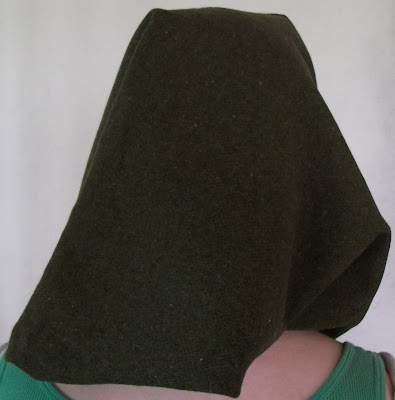
If you want less of a peak, then I would suggest fiddling with scraps of the sheet to experiment until you find a look you prefer.

The folded edge will end up being the top of the hood, the straight cut edge will be your facial opening, and the short 12” sides will be the neck. Pin the curved edges of the wool together and sew. Repeat for the lining. Put both pieces together and pin along the opening. I forget which side goes to which. I simply put them on top of my head and arranged them so that all the wrong sides would end up on the inside and all the right sides on the outside. Sew and turn right-side out. I put a couple of stitches by hand at the peak of the hood by hand to keep them together.

More garb nazi-sms.

11:28 AM Posted In , , , Edit This 4 Comments »
Pirates are not period to the SCA. Neither are modern bellydance outfits. No, not even tribal. That's what Sea Dog is for. Just stop it. You're not Johnny Depp.
I've had a couple people tell me stories of people telling them that their entire outfit was not period specific to a certain type of event, for example SCA or Ren Faire. And they've said, "I think they were just jealous." After listening to the descriptions of said garb, yes, it sounded beautiful and elaborate, according to the speaker. Did it sound historically appropriate to the event? No. Would I be envious of 18th century court garb? Yes. Is it appropriate to the even it was worn to? No.
A friend of mine went to a Ren Faire with me way back when we were poor college students. All she had, as it was basically her first event, was a black velvet and purple satin Victorian-ish dress. I helped put her in it, and I knew that it wasn't Renaissance. Someone did come up to her and point out that it was not period appropriate. We jumped to her defense, pointing out that it was last-minute, all she had, her first event, and it was better than mundane clothes. That shut her up and sent her on her way. If you have a good reason for wearing what you are, that'll shut up just about anyone who's rude enough to do that. Just don't say that you didn't know any better, that'll usually just start a sanctimonious never-ending lecture.
My first ever event was Shrewsbury. I wore black pants, grey polyester tied around my calves with leather, a white t-shirt, and a holey grey material shot through with silver metallic threads made into a tabard that looked kinda like chainmaille if you used your imagination. My hair was back in two french braids, and the ever-present bangs. And a walking stick. Why the walking stick? I had just had foot surgery and was stuck in a medical shoe. I wasn't even supposed to be walking around all day like I did. Thus the cheap, quick, comfortable, and easy garb that did it's best to hide the medical shoe. The next year, another foot surgery. Shiny polyester chemise (it was given to me, and all I had), corset, cotton underskirt, and black cotton split overskirt. If I can make attempts at making them myself even while incapacitated by surgeries, anyone can. And I still looked more historically accurate compared to the faerie twits in green bikinis.
Even garb nazis don't expect your first, or even your second and third, outfits to be perfect. Or at least they shouldn't.

Garb Nazi

9:16 AM Posted In , , , Edit This 0 Comments »
I'll admit, I'm a slight garb nazi. The sight of "shiny" fabrics (polyester, nylon, and other obviously plastic materials), makes me want to twitch. Now that's not saying that I expect everyone to be able to afford 100% pure linen/wool/and/or silk. But cotton is cheap. No, it's not strictly period, but it also breathes and is less likely to give you heatstroke, as well as a sight better than non-natural materials. There are even cotton/linen blends, also cheaper. And who would want to drag silk through muddy camping events? In fact, that's part of the reason why I encourage natural fabrics, they are so much easier to clean. And aren't terribly expensive if purchased in-season. Ssh, don't tell anyone, but I'm making a cloak out of an old, green, Army blanket. It's pure wool and a great colour. I just need some lining. Sometimes, it does pay to be short.
Neon colours are not period, most purples are not period and/or are restricted to certain classes. There are lots of colours that are historically accurate, and disguise dirt from outdoor events really well. Or you can have fun and dye the fabric yourself. Personally, I lack that talent to a degree.
Then there's construction. I like to take my anality to a point in that regard. I'm not about to sew a chemise by hand when it's not going to be seen and I have a perfectly good sewing machine. Will I do the neckline by hand? Most likely. Will I construct it as accurately as I can, rather than just cutting out a "T"? Yes. When making a cotehardie will I research how they were constructed and try to make it as historically accurate as possible? Most likely not with my 100% pure linen that I paid out the ass for. I'll buy a modern pattern and tweak it just enough to get the right silhouette.
I have access to a commercial heavy duty grommet machine through my job, but I won't use it. Metal grommets were not used, instead they were basically button-holes. I'll try and do all the buttonholes by hand, first.
As for hose, I'm not about to attempt to make nor wear them. I will knit myself a pair of stockings, which weren't technically introduced to my area until Queen Elizabeth. But socks were often knitted, so I see it as a cheap, quick, easy "cheating" way. But I will make them with a fairly historically accurate pattern, with the right colour, and out of wool with a teeny bit of nylon for strength in it, then tie them with garters.
I do research what hairstyles/head coverings are appropriate for each outfit, which are going to span a couple of centuries. I like to play with different outfits, patterns, etc. This is particularly important as I have a very modern haircut: shoulder-length, layered, and with bangs. (I am working on growing it out, except for the bangs. Wide, expansive foreheads are not popular in the 21st century). My first attempt at a veil was an unmitigated failure, it kept wanting to fall off the back. But I am trying hairstyles and coverings to disguise it.
Then there's the disguising of modern camping gear. Working on that. It's a bit more difficult than garb as I lack woodworking (other than burning designs), blacksmithing, and other skills that would make it easier. And I lack the interest. But I will try to at least hide my nylon tent with fabric and keep other things hidden.
I don't have a lot of money. I'd rather save it for going to events rather than my garb. I will take money-saving shortcuts where possible. For example, I can't afford hankerchief weight linen for a chemise. That's what cheap, thin, white cotton from Joanne Fabrics is for. I then construct it as historically correct as I can in order to appease my OCD side.
There are lots of cheap, effective ways to pass the 10-foot rule. They just require a little creativity, some time, and effort. Does this mean that I'm going to walk up to a stranger and tell them how their garb is wrong? Heck no. If asked for my opinion, I will try and do so tactfully. Does this mean that if asked for help, I'll try and steer someone to some research and resources? Yes. Am I the final authority? Considering that I've been in the SCA less than a year, that would be a resounding no.
Here is a blog with some great points on why being called a "garb nazi" is just as rude as someone pointing out the flaws in your garb, as well as why authenticity is important in the SCA.